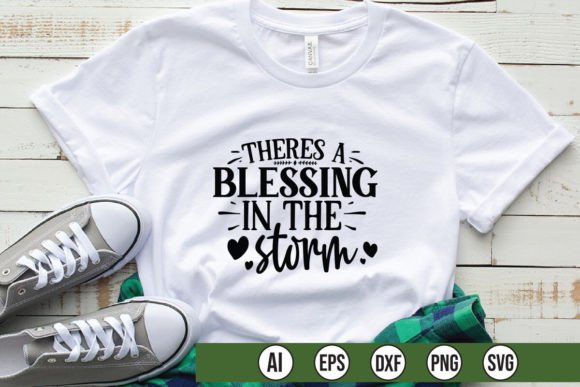
There’s a Blessing in the Storm
As someone who’s digitized, stitched, and sold embroidery designs for over twelve years—first in boutique apparel shops, then as a full-time digital product creator—I approach every new file with equal parts curiosity and caution. When There’s a Blessing in the Storm landed in my inbox, I didn’t just open the ZIP. I paused. Not because it’s flashy or complex—but because its quiet strength is exactly what makes it tricky to evaluate at first glance.
I tested it on a natural linen tote bag for a local gift shop client: soft, unbleached, slightly nubby fabric, medium weight. No stretch, no sheen—just honest texture. The design sat beautifully centered above the pocket, and after stitching, it held its shape without pulling or puckering. That told me something important: There’s a Blessing in the Storm isn’t shouting. It’s breathing with the fabric—not fighting it.
A Design That Feels Like a Handwritten Note
The layout is gentle but intentional: a softly curved cloud motif cradles delicate script lettering, with subtle raindrops trailing downward like quiet punctuation. There’s no heavy outline, no aggressive satin stitch borders—just balanced fill stitches and fine running-stitch accents that suggest movement, not rigidity. It reads as hopeful, grounded, and deeply human. Not overly religious, not vague enough to feel generic—it lands somewhere between comfort and conviction.
This makes it ideal for products where emotional resonance matters more than visual impact: baby onesies, nursery pillow covers, kitchen tea towels, maternity sweatshirts, or condolence gifts. I wouldn’t use it on a high-energy festival T-shirt—but on a hand-stitched apron for a small-batch baker? Absolutely. It adds warmth without clutter.
Where It Shines—and Where It Needs Care
There’s a Blessing in the Storm performs exceptionally well on stable, medium-weight fabrics: cotton twill, brushed poly-cotton blends, midweight denim, and even some fleece-backed sweatshirts (with proper cutaway stabilizer). On those surfaces, the stitch density feels thoughtful—not too sparse to read, not so dense it overwhelms the garment. The lettering remains legible at 3.5 inches wide, and the cloud elements retain their soft edges without bleeding into each other.
But here’s what I watched closely: the fine raindrop details. On textured fabrics like bouclé or thick terry cloth, those tiny running-stitch drops can disappear—or worse, snag during trimming. And on dark fabrics, especially navy or charcoal, the light-gray thread suggestion in the mockup didn’t translate cleanly; I swapped to off-white and added a light underlay. Always test on scrap first.
It’s also not built for tiny hoops. Below 4” x 4”, the spacing tightens uncomfortably—letters start to crowd, and the cloud loses its airy quality. For caps or curved surfaces, I’d recommend resizing *down* only to 3.75” wide max, and re-digitizing the curve alignment if your software allows. The included vector files (AI, EPS, SVG, DXF) make that possible—but don’t assume the embroidery file itself is optimized for every surface.
Real-World Fit for Real Businesses
For Etsy sellers and handmade shop owners, There’s a Blessing in the Storm is a quietly powerful asset. It’s not trendy—it’s timeless. That means slower burn, longer shelf life, and stronger repeat appeal. I’ve seen similar themes sell steadily through spring and early fall, especially around baby showers, teacher appreciation, and caregiver support bundles.
Its PNG and JPG mockups are clean and versatile—ideal for listing thumbnails, Instagram carousels, or printable lookbooks. Because the background is transparent, you can drop it onto any fabric swatch, lifestyle photo, or branded template without clipping headaches. That saves hours when updating seasonal collections.
But—and this matters—if you’re selling finished embroidered products commercially, double-check the license terms included in the instructions. The fact that it’s “100 editable” and “100 color changeable” suggests flexibility for customization, but doesn’t automatically grant unlimited commercial rights for physical goods. Read before you stitch.
Design Integrity Meets Customer Trust
What makes There’s a Blessing in the Storm stand out isn’t technical perfection—it’s emotional clarity. Customers don’t buy embroidery files; they buy meaning, memory, and intention. When someone orders a personalized baby blanket with this design, they’re not choosing aesthetics alone. They’re choosing tone. And this design delivers that consistently.
That builds trust. A well-executed stitch job with balanced tension, clear letterforms, and harmonious thread colors tells your customer: *I paid attention.* And because the file includes high-res PNGs and layered mockups, you can show that care before the first needle drops—whether you’re sending a proof to a client or prepping an Etsy listing.
Practical Notes from My Hoop to Yours
- Always stitch a test run—especially on your target fabric and stabilizer combo. Linen behaves differently than cotton poplin, even with identical settings.
- Check contrast early: view the design in black-and-white mockups to assess readability on light vs. dark garments.
- Review small details in your embroidery software: zoom in on the raindrops and inner cloud curves. Are stitch jumps minimized? Is there excessive underlay?
- Use appropriate stabilizer: medium-weight cutaway for knits, tear-away for stable wovens, and avoid heat-away unless you’ve confirmed heat tolerance.
- Confirm licensing scope before bundling it into digital embroidery packs or reselling as part of a craft business kit.
- Respect the rhythm: this design gains power from space and subtlety. Don’t overcrowd it with companion motifs unless you’re confident in scale and balance.
In the end, There’s a Blessing in the Storm isn’t just another T-Shirt Designs graphic—it’s a considered piece of visual language. It works because it doesn’t try to do everything. It sits gently on a sweatshirt cuff, anchors a baby bib with tenderness, or turns a plain kitchen towel into something quietly meaningful. For designers, sellers, and makers who value intention over intensity, it’s a rare find: simple, sincere, and ready for real life.