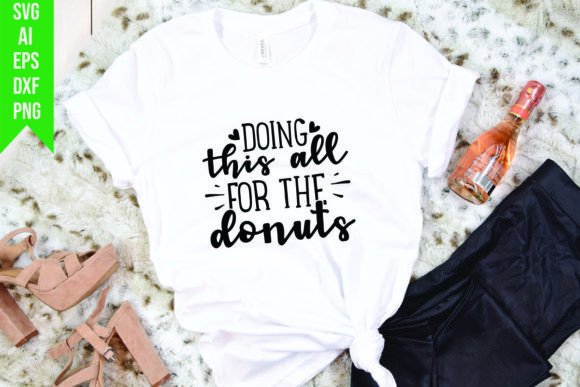
Doing This All for the Donut s
As someone who’s stitched thousands of designs—from boutique baby onesies to Etsy bestsellers—I opened Doing This All for the Donut s expecting charm, not complexity. What I found was a refreshingly balanced machine embroidery design: playful without being cutesy, bold without sacrificing clarity, and versatile enough to hold its own on everything from a linen tea towel to a heavyweight sweatshirt.
Last week, I used it to embroider a set of cotton canvas tote bags for a local bakery’s holiday pop-up. The client wanted something joyful but not juvenile—something that felt handmade, not mass-produced. Doing This All for the Donut s landed perfectly: the looping script, the soft curve of the donut outline, and the subtle weight of the letterforms gave each bag personality *before* the needle even touched fabric.
A First Stitch That Feels Like a Conversation
The design reads as friendly, confident, and lightly nostalgic—not ironic, not overly polished. It’s the kind of graphics you’d trust on a small-batch apron or a personalized gift for a teacher who bakes on weekends. There’s no aggressive kerning or cramped spacing; the letters breathe, the donut shape anchors the composition, and the overall footprint sits comfortably in a 4" x 4" hoop—ideal for standard embroidery setups and small-shop production.
I appreciated how the curves translate cleanly into satin stitch paths. No jagged corners, no awkward transitions between fill and outline. That matters when you’re stitching on textured fabrics like terry cloth towels or looped cotton kitchen linens—Doing This All for the Donut s avoids thin, fragile lines that vanish under dense fill or get lost in pile.
Where It Shines—and Where to Pause
This design excels on stable, medium-weight fabrics: cotton twill for patches, fleece-lined sweatshirts, midweight denim totes, and brushed poly-cotton tees. On those surfaces, the lettering stays legible at 3.5", and the donut motif reads instantly—even from across a craft fair booth.
But here’s where real-world testing mattered: I ran it on a lightweight rayon-blend baby onesie. Without proper cutaway stabilizer and reduced stitch density, the script blurred slightly at the tails of the “s” and “l”. Not a dealbreaker—but a reminder that Doing This All for the Donut s isn’t “set-and-forget.” It rewards attention to fabric texture and stabilizer choice.
It also behaves well on dark fabric—especially with high-contrast thread (think creamy white or soft gold on navy or charcoal). The clean outlines and generous spacing mean shadows don’t swallow details. That’s rare in T-Shirt Designs built around whimsical themes. And yes—it works for applique design too: the donut shape lends itself beautifully to a simple fabric base with satin-stitched edge.
Real Projects, Real Expectations
- Custom apparel: Perfect for unisex crewnecks or relaxed-fit tees—adds warmth without clutter.
- Sweatshirt embroidery: Holds up on brushed fleece, especially when paired with matte polyester thread for low-sheen texture.
- Embroidered patch: Clean edges and moderate density make it ideal for sew-on or iron-on backing.
- Baby embroidery: Works on bibs and burp cloths if sized down to 2.75" and stitched with ultra-soft thread.
- Holiday embroidery: Paired with cinnamon-red or mint-green thread, it reads as cozy—not kitschy—for cookie swaps or coffee-themed gifts.
- Small shop product: Looks premium in mockups thanks to the included high-res PNG and JPG files with transparent backgrounds and professional lighting.
What the Files Tell You (and What They Don’t)
The package delivers what it promises: 100 editable files, 100 color-changeable layers, and formats spanning AI, EPS, SVG, DXF, PNG (300 dpi), and JPG mockups. That flexibility is invaluable—whether you’re prepping for a commercial embroidery job in Wilcom or building a digital product bundle for your Etsy shop.
But—and this is critical—the file list doesn’t specify stitch count, recommended hoop size beyond visual cues, or commercial license scope. As a designer who sells finished embroidered goods, I double-checked the instructions for usage rights before listing any items. Always do the same. If you’re a craft business owner bundling this as part of a printable mockup pack or digital embroidery file collection, confirm licensing covers redistribution.
Design Notes You’ll Actually Use
- Test on scrap fabric first—especially stretchy knits or loosely woven linens. Adjust tension and stabilizer accordingly.
- Check thread color contrast early. A pale yellow donut on beige fabric disappears; try mustard or toasted almond instead.
- Review stitch density in the curved sections—some machines slow down or skip on tight arcs. If needed, simplify with a running stitch guide layer.
- Confirm hoop size compatibility. While it fits standard 4" hoops, verify clearance on caps or curved surfaces—this design wasn’t built for complex 3D embroidery.
- Inspect tiny details: the dot over the “i” and the curl of the final “s” are charming but can vanish on thin fabric. Consider slight enlargement or reinforcing with a second pass.
- Test black-and-white mockups. Does it retain character without color? For Doing This All for the Donut s, it does—proof of strong silhouette and proportion.
- Compare light vs. dark background mockups. The included JPG mockups help visualize both—use them to guide your product photography.
- Use proper stabilizer: tear-away for stable wovens, cutaway for knits, and fusible for lightweight blends.
Why It Builds Trust—Not Just Traffic
Customers don’t buy fonts or clipart—they buy feeling. When someone chooses a handmade product with Doing This All for the Donut s stitched front-and-center, they’re choosing joy, approachability, and intention. That translates directly to repeat buyers, social shares, and word-of-mouth referrals.
For Etsy sellers and small shop owners, that emotional resonance matters more than trend-chasing. This design doesn’t scream “viral”—it whispers “I made this just for you.” And in a market saturated with generic graphics, that quiet confidence is the most valuable stitch of all.